

Giving Wildlife a Voice

The recent discussion surrounding the seasonal golden eagle closure on Wildcat Mountain generated a lot of support, a lot of questions, and an opportunity to talk about one of the tools we use to protect wildlife: trail cameras.
When people think about trail cameras, they often think about enforcement.
Sometimes they do help with enforcement, but that's only a small part of the story.
At their core, trail cameras help us understand what is happening on the landscape. They allow us to monitor wildlife, evaluate whether conservation efforts are working, and document changes that occur over time. Most importantly, they help give a voice to wildlife and the land itself.
The current golden eagle closure is a good example.

Golden eagles have successfully nested on Wildcat Mountain since 2011, producing 12 fledglings over 16 years. Each spring and summer, we implement a seasonal trail closure to protect the nesting pair during one of the most sensitive periods of their life cycle. Trail cameras help us monitor the closure, understand how people are interacting with the area, and identify potential disturbances that could impact nesting success.
Fortunately, that support does not come from staff alone. For 16 years, the overwhelming majority of visitors have respected seasonal closures and understood that sometimes, wildlife simply needs a little space. The individuals who choose to ignore these closures represent a very small percentage of trail users. Most people care deeply about conservation and want to do the right thing, especially once they understand why a protection is in place.
That community support is one of the reasons conservation continues to succeed here, but one of the most important lessons we've learned from trail cameras comes from a different wildlife story.
When the Wildcat Mountain Trail System opened in 2006, a seasonal closure was established from January 1 through April 1 to protect an important elk wintering area. Long before trails existed, large numbers of elk spent the winter there. The area contains the property's only natural water source: a small creek that allows elk to remain close to water during a season when conserving calories can mean the difference between survival and starvation.
For years, the closure remained in place. But over time, we noticed something troubling.
The elk seemed to be disappearing from the area during the winter months.
By the mid-2010s, winter elk use of the area had declined substantially. By 2018, elk were rarely present compared to what we had historically observed. After more than a decade of seeing fewer and fewer elk, we began asking a difficult question: If the elk weren't using the area anymore, did the seasonal closure still serve a purpose?
At first, it seemed possible that the answer was no. Years of field observations suggested another possibility.
Every winter, there were signs that some people were entering the closed area. Individuals were bypassing gates and signs, hopping fences, and ignoring the closure. The challenge with wintering elk is that it doesn't take many disturbances to create a problem. Often, a single person entering the area is enough to cause a herd to leave, burning precious calories.
A familiar reality of wildlife conservation is that a small number of disturbances can have a disproportionately large impact. A couple poorly-timed disturbances can cause a nesting eagle to abandon a nest. A few encounters with hikers can force an elk herd to avoid an area altogether.
The habitat itself had not changed. The creek was still there. The reasons elk had historically used the area were still present. Maybe the problem wasn't the elk. Maybe the problem was that we weren't doing enough to protect the closure. Before eliminating it, we decided to try something different.
We focused on education.
Conservation is dependent on people making good decisions. Over the years, we've learned that when people understand why a closure exists, they are far more likely to support it. Signs, blogs, social media posts, public programs, and conversations with visitors all serve the same purpose: helping people understand how their individual choices affect wildlife.
We installed signs explaining not just the rules, but the reasons behind them. We wanted people to understand that wintering elk depend on undisturbed habitat and access to water to conserve precious calories during the most challenging season of the year.
The signs helped.
Then we added trail cameras. The cameras helped us better understand what was happening on the landscape. They created awareness for us as land managers, and they helped us create awareness within the community. In many cases, the greatest value of trail cameras is not enforcement, it's education. They allow us to tell stories that would otherwise go unseen and help people understand why certain protections matter.
That helped even more.
Later, we began sharing examples of violations on social media. Not to publicly shame individuals, but to educate the broader community about an issue that most people never saw, because awareness matters.
The purpose wasn't to embarrass anyone. The purpose was to remind people why these closures exist, why they matter, and how individual actions can affect wildlife. The response we've seen from the community reinforces something we've always believed: people care deeply about protecting these resources.
Over time, violations declined. Then, something else happened.
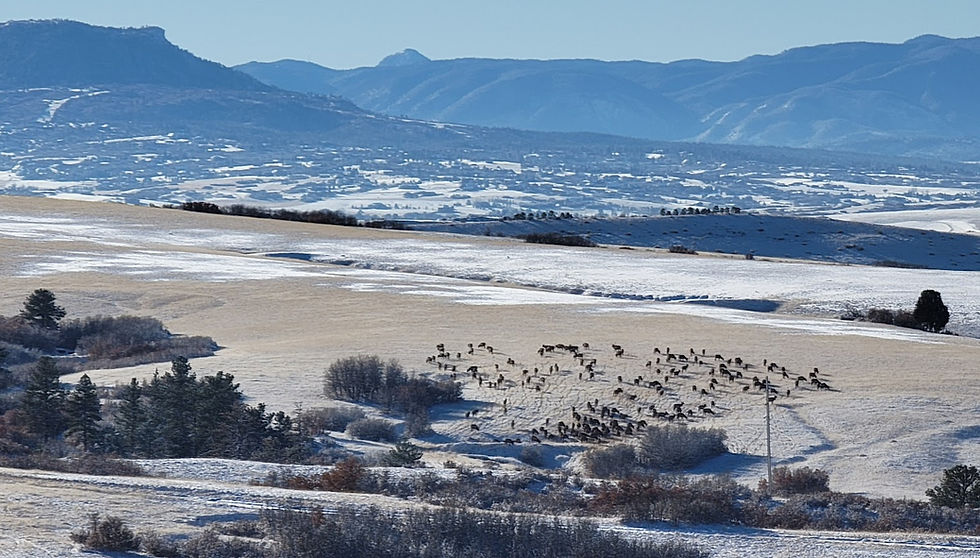
The elk started coming back.

This wasn't a formal research project, and we are not claiming a direct cause-and-effect relationship. But after nearly two decades of observing this landscape, the pattern was hard to ignore. As education improved, compliance improved. As compliance improved, elk began using the wintering area more frequently.
The lesson wasn't that trail cameras solved the problem. The lesson was that education, awareness, community support, and accountability worked together to solve the problem.
The cameras were simply one of the tools. That is how we view conservation.
Trail cameras help us understand whether we are succeeding in our responsibility to the land and wildlife.
Sometimes they capture a golden eagle closure violation. Sometimes they capture a cow elk leading her newborn calf across a dirt road. Sometimes they capture a black bear and cub playing in the forest. And sometimes they reveal a problem that wildlife has been trying to tell us about for years.
The reality is that conservation in a place like Highlands Ranch requires partnership. Wildlife here does not have unlimited room to roam. The Backcountry Wilderness Area is an island of conservation surrounded by development, and successful conservation depends on thousands of people making small decisions every day that collectively benefit wildlife.
Seasonal closures, thoughtfully designed trails, leash requirements, habitat restoration projects, educational programs, and other management practices only work when the community participates in them.
The wildlife that live here do not have a voice in today's decisions. Neither do the future generations who will inherit these lands. Part of our responsibility is to advocate for both. Trail cameras, educational signs, research, community outreach, social media, and partnerships with law enforcement are all tools that help us do that.
Conservation and recreation are not opposing goals. They are partners. But that partnership only works when all of us understand the role we play in protecting the wildlife and habitats that make this place special.
The success of our nesting golden eagles. The return of elk to an important wintering area. The bears, elk, deer, mountain lions, and countless other wildlife that continue to use these lands. None of these are solely the result of cameras, rules, or closures. They are the result of a community that increasingly understands that conservation depends on people making good decisions.
We are fortunate to live in a place where people value both recreation and wildlife. That support allows us to strike a balance that is increasingly rare in a rapidly developing metropolitan area.

We cannot do this work alone. Wildlife conservation is most successful when it becomes a shared responsibility.
Fortunately, that is exactly what we see happening here.


Comments